
Shadows
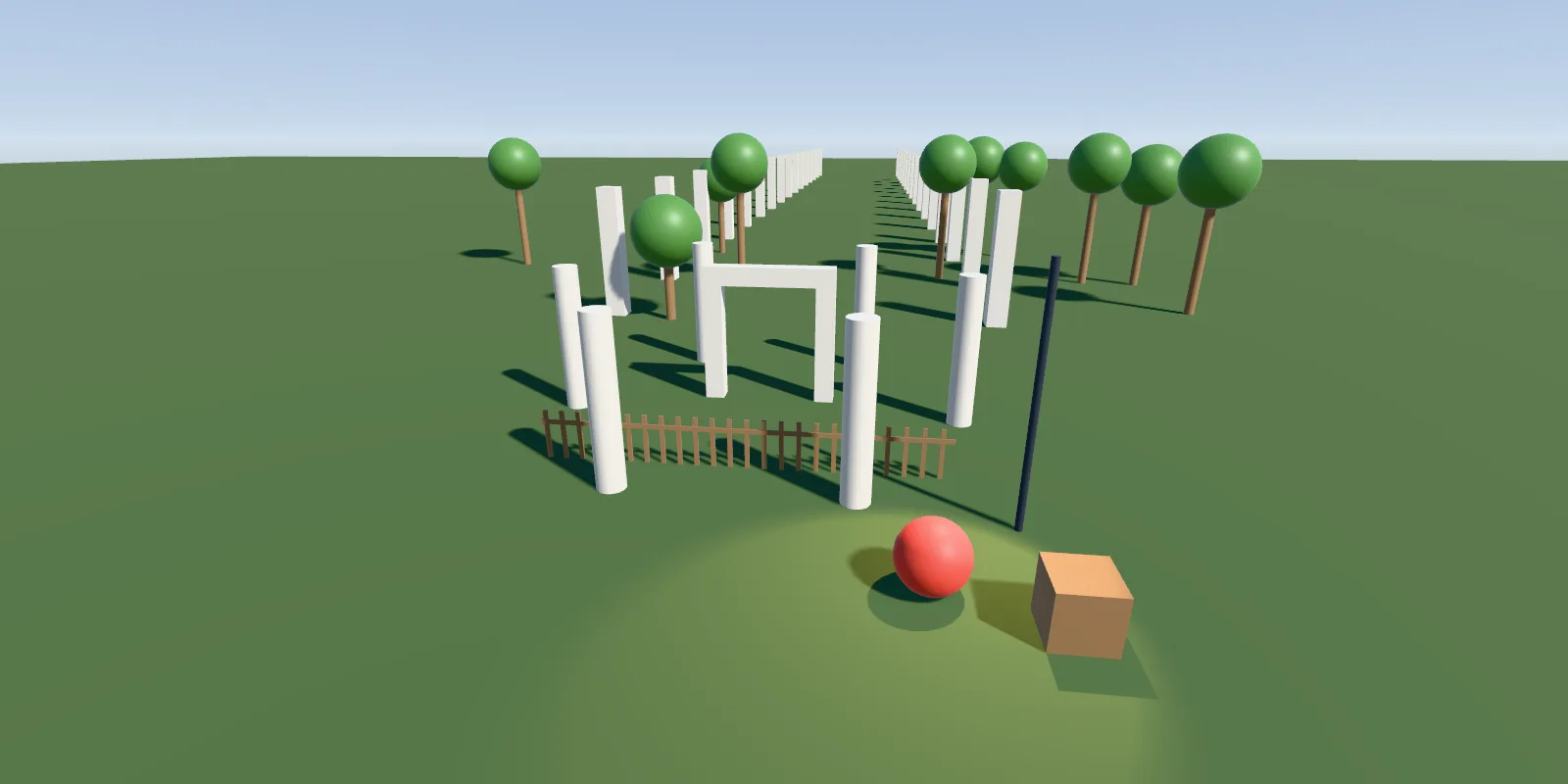
A sun casts shadows unless it’s made with shadows: false, as a new
scene’s sun does in Unity; a spotlight casts them when asked. Every
object casts them and has them fall on it, unless its renderer says not:
/// A low evening sun, casting long shadows.GameObject eveningSun() => GameObject(components: [Light.sun(direction: Vec3(-0.6, -0.5, -0.4), intensity: 2)]);
/// A spotlight 4 m up, pointing straight down, casting shadows.GameObject stallLight() => GameObject(  transform: Transform(position: Vec3(0, 4, 0), rotation: Quat.lookRotation(Vec3(0, -1, 0), up: Vec3(0, 0, -1))),  components: [Light.spot(range: 8, angle: 60.deg, shadows: true)],);
/// A puddle: it shadows nothing, but shadows fall on it.MeshRenderer puddle(Material water) => MeshRenderer(Mesh.cylinder(), water)..castShadows = false;light.shadows, renderer.castShadows and renderer.receiveShadows can
change at any time. The lab’s ‘Look: shadows’ scene shows the sun’s and a
spotlight’s, at each level.
The sun’s shadows
Section titled “The sun’s shadows”The sun’s shadows reach the quality’s shadowDistance from the camera
and fade out there (less if the camera’s far is nearer). They’re drawn
into shadowCascades maps seen from the sun, with shadowSoftness edges:
at low one map with soft edges, at medium two, at high three with softer
ones. With more than one, the nearest covers least, so shadows near the
camera are sharpest.
How sharp they are
Section titled “How sharp they are”How sharp they are is the map’s texels spread over the distance it
covers: halve shadowDistance and they’re twice as sharp. Keep it to what
the game needs shadowed. A table-top game seen from 2–3 m wants 10–20 m; an
open field, 60 or more with cascades.
Low’s single 1024 map over 20 m keeps a wall’s shadow smooth on a phone;
over 40 m it’s saw-toothed. A bigger map is sharper too, at four times the
memory each step: shadowResolution: 2048 is 8 MB a map, 1024 2 MB. Soft
edges cost the Note10+ about 1 ms of GPU a frame over hard ones, and a 2018
iPad about 2.
A quality with shadows: false draws none, whatever the lights ask. The
maps move with the camera a whole texel at a time, so a still shadow’s edge
doesn’t crawl as the camera moves. Only the first sun with shadows casts
them.
A spotlight’s shadows
Section titled “A spotlight’s shadows”A spotlight’s shadows reach as far as its range. Each frame gives a
few spotlights shadows, the ones nearest the camera: 1 at low, 2 at medium,
4 at high. The others still light, without shadows. A spotlight with shadows
is at most 150° across: a wider one is refused with an ArgumentError,
since its shadow map can’t cover the rim.
Point lights don’t cast shadows
Section titled “Point lights don’t cast shadows”Point lights don’t cast shadows yet. A torch that should throw shadows is a point light for its glow and a spotlight with shadows above it, aimed down.
castShadows: false
Section titled “castShadows: false”castShadows: false is for what shouldn’t darken the ground (a glow,
water, a ghost) and for what can’t shadow anything (a flat floor), which
also saves drawing it into the maps. receiveShadows: false keeps
shadows off an object.