
Splines
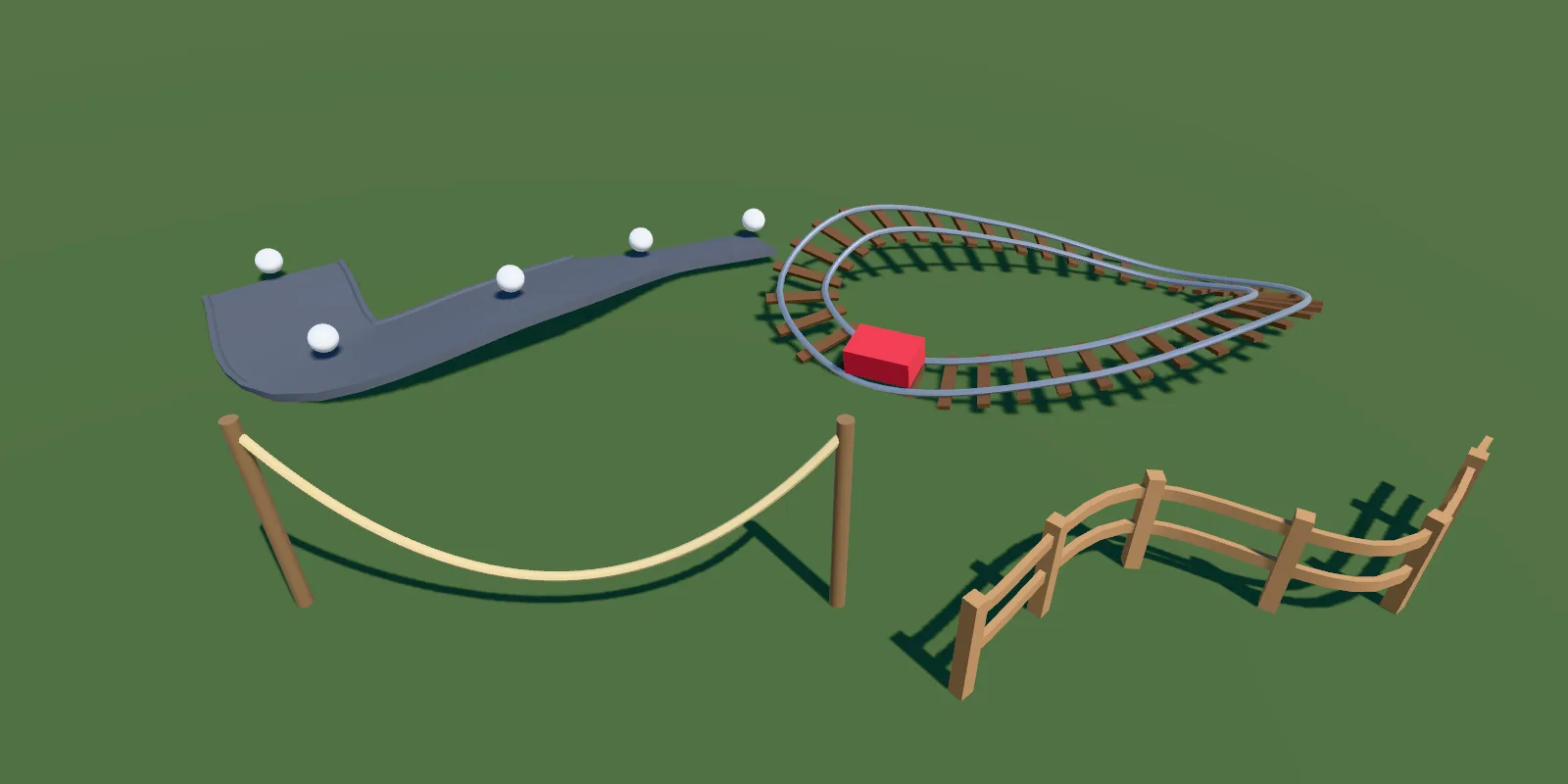
A Spline is a smooth curve through knots, as Unity’s: a road, a river,
a rope, a cart’s track, where the fence posts go. It’s plain Dart, so a
game uses it to move and place things as much as to make meshes.
// Smooth through every point (Unity's auto tangents), or straight lines// between them (Spline.linear), or knots with their own handles.final river = Spline.smooth([Vec3(0, 0, 0), Vec3(8, 0, -4), Vec3(16, 0, 2)]);final arch = Spline([  Knot(Vec3(0, 0, 0), mode: TangentMode.bezier, tangentOut: Vec3(0, 3, 0)),  Knot(Vec3(5, 0, 0), mode: TangentMode.bezier, tangentIn: Vec3(0, 3, 0)),]);
// Everything along it is by distance in metres.final halfway = river.positionAt(river.length / 2);final facing = river.rotationAt(3); // -Z along it, up as upAtfinal closest = river.nearest(Vec3(5, 0, 5)); // (distance:, position:)
// A road: a profile swept along it, caps on its ends, UVs in metres:// u around the profile, v along the path. setSweep sweeps again into the// same mesh, or into an empty Mesh() the first time.final road = Mesh.sweep(river, Shape2D.rect(4, 0.3), segmentsPerMetre: 2);
By distance, not t
Section titled “By distance, not t”positionAt, directionAt, upAt and rotationAt
take metres along it, so things go at an even speed and are evenly spaced;
Unity’s normalised t is distance / length. A closed spline joins its
last knot to its first and distances go round.
Up turns as little as it can along the curve (a rotation-minimising
frame), so a tube doesn’t twist where it bends; it starts as +Y, and a
knot’s roll turns it, clockwise seen going along: a banked turn. It keeps
no world up, as Unity’s knots do: where the curve climbs as it bends, and
round a closed loop, up comes out rolled a few degrees, so a road swept
along it leans.
For a level road, measure each knot’s lean (the angle between upAt and
world up, both square to directionAt) and set the knots again with roll:
minus it.
Changing it
Section titled “Changing it”spline[i] = Knot(...), add, insert, removeAt, or
setPositions(floats) for every knot at once; version goes up each time.
mesh.setSweep(spline, shape) sweeps again into the same mesh: a road whose
knots are dragged, or a rope that swings each frame, which makes no garbage
when it’s filled with setPositions, and allocates nothing in the engine
either once it has swept one that size. The caps are filled once while the
shape stays the same.
Samples
Section titled “Samples”segmentsPerMetre (2 unless given) and more where it bends, at
most maxSegments. A 100 m road with a 12-point profile takes about 0.06 ms
in Rust on a Mac.
On objects
Section titled “On objects”On objects, as Unity’s Splines package has them:
/// A track round [points] with sleepers along it, and a cart riding it.List<GameObject> railway(List<Vec3> points, Mesh sleeper, Material wood, GameObject cart) { final track = GameObject(components: [ SplineContainer([Spline.smooth(points, closed: true)]), // Sleepers every 35 cm, placed again when the spline changes. SplineInstantiate((i) => GameObject(components: [MeshRenderer(sleeper, wood)]), spacing: 0.35), ]); cart.addComponent(SplineAnimate(track.get<SplineContainer>()!, speed: 2, loop: SplineLoop.loop)); return [track, cart];}SplineContainerholds splines in its object’s space: move the object and they move with it. ItspositionAtand the rest answer in the world, distances included: on an object scaled 2,length()is twice the spline’s, andpositionAt(5)is 5 m along in the world.SplineInstantiatemakes copies with its function, hung from its object,spacingmetres apart (along the spline in its own space, so scaling the object spaces them out with it) orcountof them, turned along the spline unlessalignis false,offsetfrom it.SplineAnimatemoves its object along at aspeedor overseconds,once,looporpingPong, turned to face the way it goes;play,pause,restart,distanceandnormalizedTime. When its container’s object is destroyed it holds still, asFollowdoes.world.debug.drawSplines = truedraws every container’s splines and knots.
The lab’s “Splines” has a road whose knots can be dragged, a rope that swings between two posts, a fence and a cart on a track (examples/lab/lib/scenes/splines.dart).